 Carter Garage Door & Gates
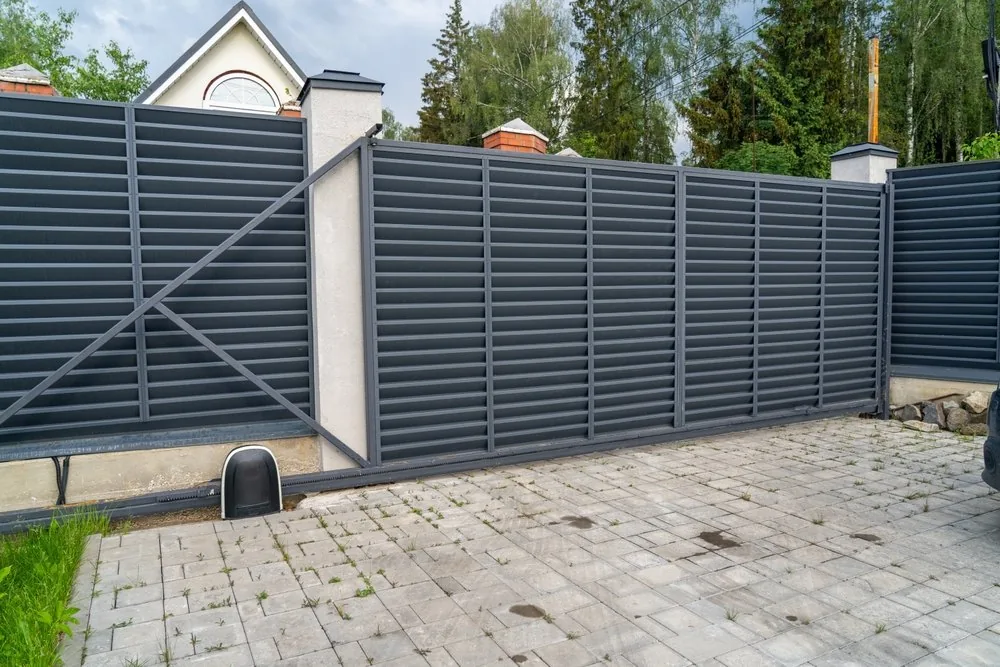
Gate operators often get picked backwards: someone buys a motor, then figures out where it goes. On a tight lot in Hudson County, layout should come first. A swing arm needs clear room for the leaf to travel in an arc; a slide operator needs a straight stretch of fence or wall for the gate to roll alongside.
If your gate already has an operator that's misbehaving, our gate opener repair page covers the usual faults. Keep reading if you're choosing a new operator or replacing a worn-out one.
Swing and sliding operators side by side
| Factor | Swing gate operator | Sliding gate operator |
|---|---|---|
| Space needed | A clear arc inside the property for each leaf to open | A straight run beside the opening, at least as long as the gate |
| Ground | The arc has to clear the driveway surface, including a rise | Needs a level, clear path along the track or roller line |
| Hardware | Linear arm, articulated arm or underground motor near the hinge | Motor box beside the gate drives a gear rack |
| Winter trouble spot | Snow and ice piled in the arc block the leaf | Ice in a ground track can stall the gate |
| Typical setting | Short, level driveways with single or double leaves | Driveways that meet the sidewalk with no room to swing |
Neither type wins everywhere. Swing operators are mechanically simple and suit short, flat driveways. Sliding operators shine where a leaf has nowhere to go, such as a driveway that runs straight into the sidewalk.
How to decide for your property
- Measure the opening and the space on each side, both inside the property line and along the fence.
- Note the slope. Does the driveway rise behind the gate where a leaf would swing?
- Check the gate's condition. A sagging leaf or binding wheel will wear out any motor.
- Plan controls: a keypad post, intercom, remotes, and a way for cars to exit without a code.
- Think about snow. Where will shoveled or plowed snow end up relative to the gate's path?
When the gate itself is tired, fitting a new operator to it rarely ends well. A new gate designed around the operator avoids fighting an old, out-of-square frame.

What UL 325 says about gate operator safety
UL 325 is the safety standard for door, drapery, gate, louver and window operators. For vehicle gates, its central idea is entrapment protection: a moving gate must not pin a person against a post, a wall or the other leaf.
Types of entrapment protection
| Type | What it is |
|---|---|
| A | Inherent sensing built into the operator; it detects an obstruction and reverses |
| B1 | Non-contact sensors, such as photo eyes across the gate path |
| B2 | Contact sensors, such as a pressure-sensitive edge on the gate's leading edge |
| C | Inherent force limiting |
| D | Constant-pressure control: the gate moves only while someone holds the button |
Installers have to provide at least two independent means of entrapment protection for each entrapment zone, and the same type can't count twice. The operator's built-in sensing usually covers one, which is why external photo eyes or safety edges show up on most installs.
The 2016 monitoring change
Since January 12, 2016, operators listed to UL 325 must check their external entrapment devices every cycle for a proper connection and correct operation. If a required sensor is missing or faulty, the operator falls back to constant-pressure control, and wireless remotes won't move the gate.
This explains a common surprise: an old gate that worked fine stops answering remotes after an operator swap. The new unit is looking for monitored sensors the old one never needed.
Where the pinch points are
A swinging leaf can trap someone in its arc and at the hinge side. A sliding gate can trap a person at the closing post and in the gap it rolls into as it opens. Sensor placement follows those zones, so a slide gate usually needs coverage in both directions of travel.
Other safety details an installer should handle
- Guard or screen openings on sliding gates where a hand could be drawn in near rollers or posts. UL 325 installation guidance points to ASTM F2200 for gate construction.
- Put the keypad or push button where the user can see the gate but can't reach through it to the moving parts.
- Mount the warning signs supplied with the operator so they're visible from both sides.
- Give people a separate walk-through gate; vehicle gates aren't meant for foot traffic.
- Plan emergency access if fire or police may need to get in.
Keeping a gate operator reliable through winter
Cold, salt and wet leaves are hard on gate hardware. A few habits make a difference:
- Wipe photo-eye lenses after snow or freezing rain.
- Keep the track or swing arc clear of ice and plow ridges.
- Check hinges, rollers and the gear rack for rust or stiffness.
- Test the reversing function monthly with an object, never a person, in the gate's path.
Carter works on both driveway gates and garage doors, so if the gate and the garage opener both need attention, one call covers the two.
Need it fixed?
Gate Opener Repair & Installation across North & Central New Jersey
Garage door or gate trouble? Carter answers 24/7, wherever you are in North or Central New Jersey.
Frequently asked questions
Does my home driveway gate need photo eyes?
For an operator listed to the current UL 325 standard, external entrapment protection is part of the design, and the operator monitors it. Without the required monitored sensors, newer operators won't respond to remotes. The exact layout depends on the gate type and its entrapment zones.
Can a swing gate opener work on a sloped driveway?
Sometimes. If the ground rises inside the leaf's arc, the gate may need to swing outward, sit higher, or hang on rising hinges. A sliding gate is another option when there's a straight, level run beside the opening.
Why does my gate move only while I hold the button?
On many modern operators, that's the fallback mode when a monitored safety sensor is unplugged, blocked or failing. Check the photo-eye lenses and wiring first. If the fault indicator stays on, the sensor or its connection needs service.
Can an opener be added to my existing gate?
Often, if the gate is sturdy, moves freely and has room for the operator. A gate that sags, drags or binds should be fixed first, because the motor will strain against it and wear out early.